



Learning Through Connection
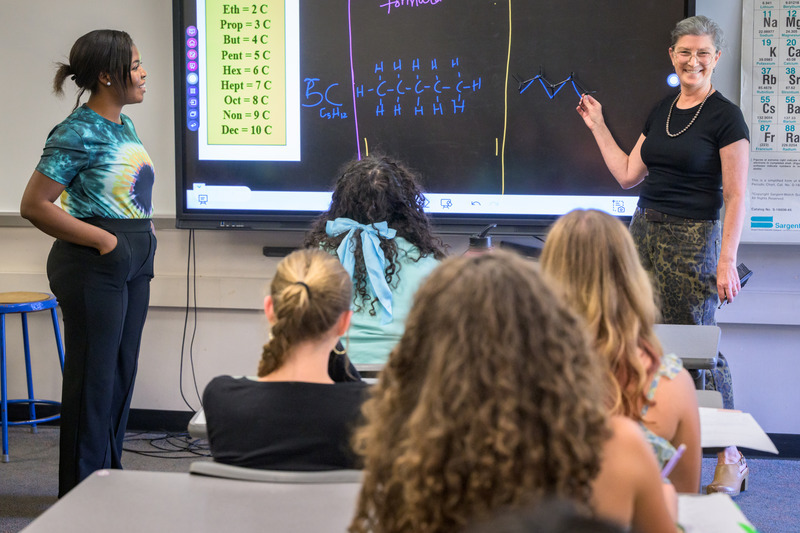
UD’s Teacher Residency program partners with Delaware teachers, supporting high-need Delaware schools through professional mentorship
Learning and connection. That’s what drew Juliet Samuel, now a high school chemistry teacher at Brandywine School District’s Mount Pleasant High School in Wilmington, to University of Delaware’s Teacher Residency program.
Housed in the College of Education and Human Development (CEHD) and funded by the Delaware Department of Education, the program allows teacher education students to pursue yearlong, paid student teaching experiences in Delaware schools.
“UD stood out to me because of its strong Teacher Residency program and emphasis on practical, hands-on learning and mentorship,” said Samuel, who studied secondary STEM education. “Coming from Nigeria without prior knowledge of the U.S. education system, this program provided me with the guidance and support to successfully navigate a new educational environment and adapt my teaching approach.”
The residency program offers many benefits, from an immersive teaching experience to opportunities to join professional learning communities. But one of the most notable is the special relationship residents develop with their teachers. Through this mentorship, the program strengthens teacher retention, alleviates teacher shortages and supports high-quality instruction across all three counties in Delaware.
Powerful pairings
Samuel was paired with Robin Rimback, a chemistry teacher at Mount Pleasant, and gradually accepted more teaching responsibility.
“Ms. Rimback played a vital role in helping me transition into the classroom by sharing her experiences, offering continuous guidance and creating a supportive environment where I felt comfortable growing,” Samuel said. “She gave me the opportunity to be myself and take ownership of the classroom, allowing me to make lessons my own during my teaching.”
Now, one year later, Rimback has retired and Samuel was hired to assume Rimback’s teaching position. Thanks to the residency program, she plans to remain teaching in the state, a program goal for all residents.

“I hope to continue teaching in Delaware long-term, as I have built strong connections here and I am passionate about contributing to the community,” Samuel said.
Another exemplary pair is Jonathan Gillock, now a teacher at his middle school alma mater, Fred Fifer III Middle School in Camden, and his mentor, former social studies teacher, Agoston Szabo.
“Residency opened up many doors for me at my school,” said Gillock, a 2025 graduate of CEHD’s elementary and middle school teacher education (EME) program. “I had coaching opportunities, references from influential people in the district and more, all because of the residency program.”
Working within the Caesar Rodney School District, he took advantage of the teacher residency’s many benefits. The New Teacher Orientation, for example, provided professional connections while offering Gillock a deeper understanding of the beginning of the school year.
At Fifer Middle School, he and Szabo developed a complementary relationship — learning with and from each other as they taught social studies together.
“When Jon and I talked to each other, sometimes I would re-evaluate myself as well,” Szabo recalled. “I would ask myself questions like, ‘Is this really the best way to teach this class? Am I grading these students correctly? Is this the best method for addressing this behavior issue?’ When Jon would question why I did things a certain way, it would help me reassess whether I needed to change as well.”

Szabo now teaches drivers’ education, and Gillock was hired for his previous position. As Delaware continues to experience a teacher shortage, the residency program helps meet that need — every resident teaches in a high-needs Delaware school district for three years after graduation.
For Audrey Price, a second grade teacher at Providence Creek Academy in Clayton, the relationship with her mentor teacher, Jennah Truitt, a kindergarten teacher at Lord Baltimore Elementary School in Ocean View, had a lasting impact.
“One of the most meaningful takeaways from my time in Jennah’s classroom was a simple yet powerful phrase she repeated every single day: ‘Mistakes help our brains grow,’” said Price, a fellow 2025 EME graduate. “At the time, I understood how impactful this message was for young learners, but I didn’t realize just how much it would shape me as an educator, as well. Now, in my own classroom, I’ve made this phrase a core part of our daily routine.”
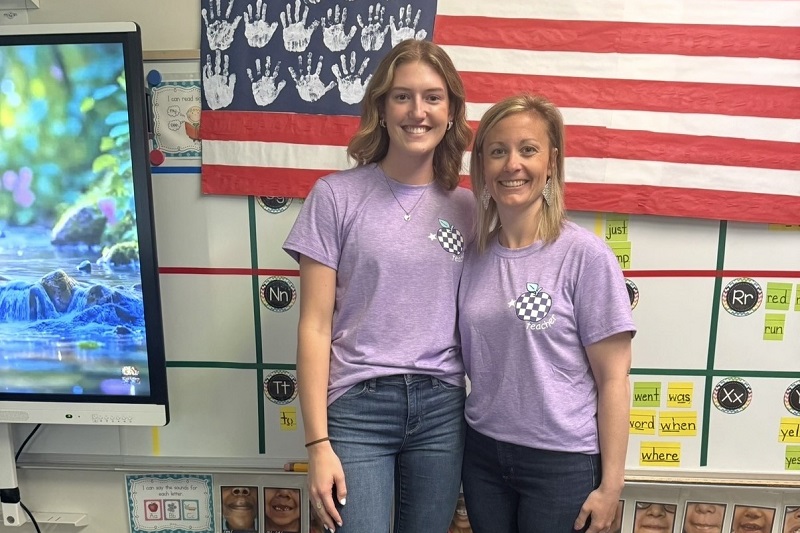
As a longtime teacher in the Indian River School District, Truitt values the ways in which the residency program directly supports and enables high-quality teaching statewide.
“The residency program allows us to intentionally develop well-prepared educators who are grounded in a warm school culture,” she said, “enhancing trust, inclusivity, vibrant relationships and equipped with real classroom experience.”
Addressing a statewide need
Since the program’s inception in 2021, UD has graduated 79 residents, all of whom now work full-time in Delaware schools. In May 2026, the University graduated its sixth cohort — a group of 19 additional residents — who will soon begin their teaching positions as full-time employees. Like Samuel and Gillock, many of the residents fill the positions of their mentors as they near retirement or pursue other opportunities.
“Graduates of the program teach in Delaware schools, directly meeting the hiring needs of high-need districts across the state,” said Maya Constantine, associate director of residencies in CEHD’s Center for Excellence and Equity in Teacher Preparation. “It’s been a privilege to work closely with districts throughout the state to support residents both before and after graduation, ensuring they have the tools and relationships they need to thrive. By blending a full-year classroom apprenticeship with rigorous coursework, the program produces better-prepared teachers who are ready to make an impact from their very first day as a teacher of record.”
Stephanie Armstrong, novice teacher educator in the Office of School Support in Red Clay Consolidated School District and longtime partner, agrees. After working with many residents, she’s observed a bolstered sense of confidence, self-advocacy and preparedness, as well as a deeper connection to their colleagues.
“The residency program is one of the most impactful programs I’ve seen regarding education,” Armstrong said. “I think that it will support filling the teacher shortage because those that are here for a year [of residency]—receiving that level of support and nurture—are more apt to stay. We all know that when people feel connected to a system, they’re more inclined to stay.”
During the 2025-26 school year, the teacher residency program partnered with six school districts across the state, including Appoquinimink, Brandywine, Christina, Indian River, New Castle County Vocational Technical and Red Clay. Next year, the program plans to expand even further.
“We anticipate 26 residents and will be partnering with all the same districts as this year, plus Caesar Rodney School District, Colonial School District, Kuumba Academy Charter District, Laurel School District and Providence Creek Academy,” Constantine said.
To learn more UD degrees in education or professional development opportunities, visit UD’s education pathways webpage, CEHD’s overview of graduate programs or CEHD’s CEETP and School Success Center.
Header image caption: Juliet Samuel (left), a former UD teacher resident and current teacher at Mount Pleasant High School, teaches chemistry with her mentor teacher, Robin Rimback (right).
Article by Jessica Henderson. Photos by Evan Krape and courtesy of Jonathan Gillock and Audrey Price.