



Steele Symposium 2026 Celebrates Student Research
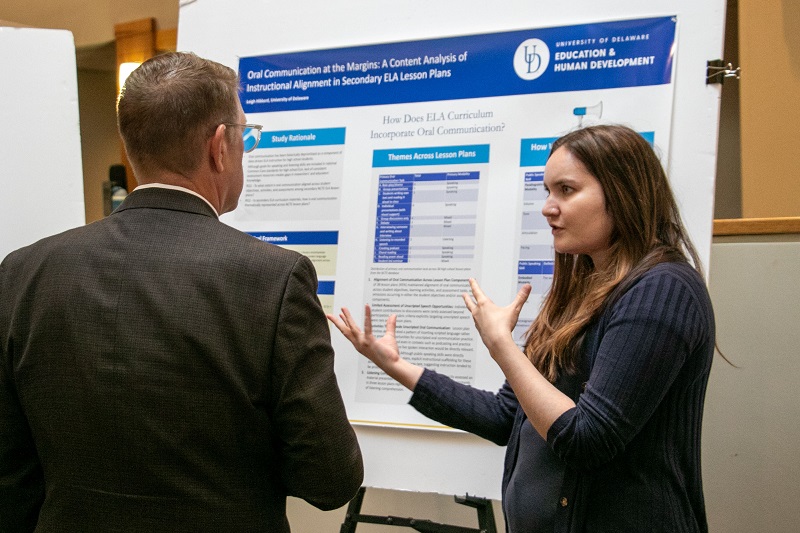
Marion H. Steele Symposium celebrates student research with panel and poster presentations and student awards
On April 24, the University of Delaware College of Education and Human Development (CEHD) hosted the annual Marion H. Steele Symposium to share and celebrate the innovative research of its undergraduate and graduate students in education, human development and related disciplines.
Since 1985, hundreds of undergraduate and graduate students have presented their research in this symposium. This year, students shared their research on early care and education, disabilities studies and math teaching and learning, among other topics with faculty, staff and fellow students.
“This longstanding college tradition brings us together as a community to celebrate the depth, creativity and impact of their scholarship,” said Rena Hallam, interim dean of CEHD, in her opening remarks. “Their work reflects deep engagement with pressing questions in education, human development and the broader social world. Across disciplines and methods, they are asking thoughtful questions, pursuing meaningful inquiry and contributing ideas that matter.”
The event featured student presentations and poster sessions, remarks from Kevin Steele, the great nephew of Marion Steele, a panel on learning and thriving across the lifespan, closing remarks from Interim Provost William Farquhar and the presentation of student awards, which recognized excellence in undergraduate and graduate research.

Kevin Steele shared fond memories of his great aunt, Marion H. Steele, is his opening remarks.
With CEHD Assistant Professor Abram J. Lyons as moderator, faculty on the panel discussed research projects that support learning and thriving across the lifespan, from early childhood to older adulthood. The panel included David Coker, professor in the School of Education (SOE), Sara Goldstein, professor in HDFS, Heather Farmer, assistant professor in HDFS, Myae Han, professor in HDFS, Jessica Namkung, associate professor in SOE, and Raphael Travis Jr., professor in CEHD.
Topics included early childhood and the importance of play, the transition from adolescence to adulthood, supporting student writing and learning in mathematics, learning and thriving in older adulthood and engagement with the arts as a therapeutic practice. The session also included a Q&A portion, which gave students an opportunity to ask questions about conducting research and working in the field.
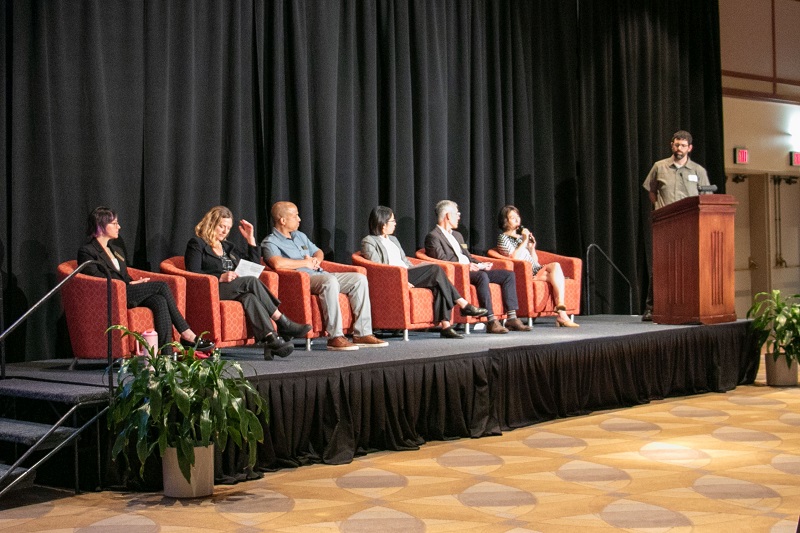
Abram Lyons, CEHD assistant professor, moderated the faculty panel on living and thriving through the lifespan.
Excellence in undergraduate and graduate research
Thanks to the engagement of CEHD students and faculty, this year’s symposium included a record number of undergraduate participants, who shared impressive research alongside their graduate peers. After the day’s panel presentations and poster sessions, several undergraduate and graduate students were recognized for excellence in student research.
Paper Awards
- Zhixian Zhuang won the First Place Graduate Paper Award for “Academic Discourse Socialization as Institutional Risk: A Global South Perspective on Chinese Students in U.S. Higher Education”
- Osmond Asiamah won the Second Place Graduate Paper Award for “Preservice Teachers’ Meanings for Area Measurement”
- Kate Bergwall won the Third Place Graduate Paper Award for “Beyond Language: Preventive Care and Oral Health Gaps Among Children in Non-English-Speaking Households”
- Julianna Ashley won the First Place Undergraduate Paper Award for “Beyond The Ruler: Examining Changes in 6th-Grade Students’ Errors on Ruler Measurements Tasks after a Fraction Sense Intervention”
- Emily Mavroudakis won the Second Place Undergraduate Paper Award for “Blurring Boundaries: An English Teacher’s Journey into the History Classroom”
- Andromeda Henderson won the Third Place Undergraduate Paper Award for “Emotional Regulation in Individuals with Developmental Dyslexia.”
Poster Awards
- Margaret Ellis won the First Place Graduate Poster Award for “Leveling Up” Discussion Practices: Pre-Service Teachers’ Enactment of Math-Talk Learning Communities through Number Talks”
- Senran (Laurence) Wang won the Second Place Graduate Poster Award for “State Higher-Education Policy and the College Wage Premium: A Replication and Extension of Fortin (2006) with Recent Evidence”
- Molly Li won the Third Place Graduate Poster Award for “Selective Uptake or Blind Trust? Student Calibration of AI-Generated Writing Feedback During Revision”
- Samantha Garber won the First Place Undergraduate Poster Award for “Tomoji Town: Differences in Student-Rated Emotions Across Subjects”
- Isabella Hayden won the Second Place Undergraduate Poster Award for “Measuring the Predictability of Unplugged Assessments: Analyzing Game-Based Programming Performance”
- Shaylah Lounsbury won the Third Place Undergraduate Poster Award for “Examining Students’ Computational Thinking in Algorithmic Questions within the CT Assessment TechCheck”
To learn more about this year’s event, its participants and the Steele Family, visit the event webpage.
Article by Jessica Henderson. Photography by Shelly Silva.