



Around the World this Winter
UD students expand academic and cultural horizons through immersive Winter Session study abroad programs
From interning at fashion companies “down under” to getting a crash course in sustainable development in Patagonia, nearly 1,000 University of Delaware students explored all corners of the globe this Winter Session. Faculty from eight colleges led 49 programs in 24 countries. Here, UDaily highlights a few of them.
Zeroing in on policy themes abroad
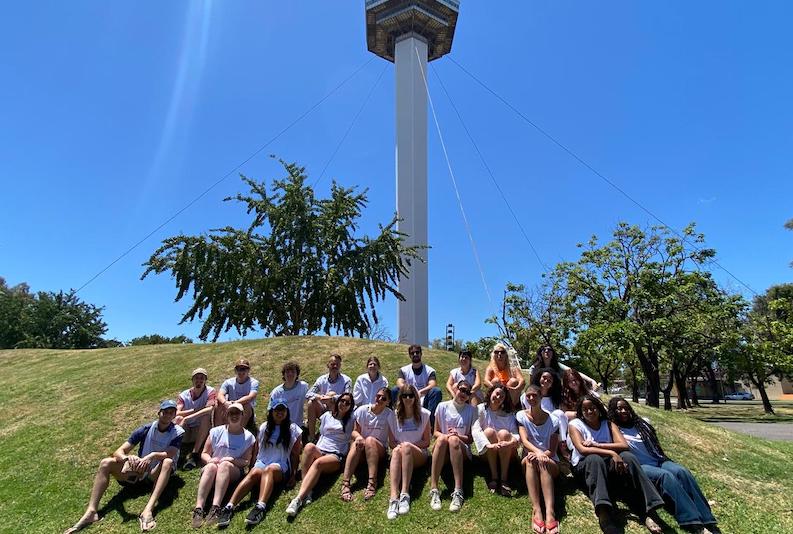
Sixteen University of Delaware students spent nearly three weeks in the capital of Argentina learning about the various and complex ways a nation’s culture uniquely impacts its policies. Led by associate professor and policy scientist Tibor Tóth, the trip focused on comparing public policy between Argentina and the U.S., zeroing in on a variety of common policy themes — from education to health and social issues. The students accomplished this through trips to food banks and long-term homeless shelters, state-funded “summer” camps for over 6,000 schoolchildren, daily travel on public transit, guest speaker presentations by sociologists and government officials, the ESMA Museum and Site of Memory, and more. These experiences helped the group learn to compare policies across nations effectively, providing them with a deeper understanding of what drives government decision-making at both the national and global levels.
Getting a crash course in sustainable development in Patagonia
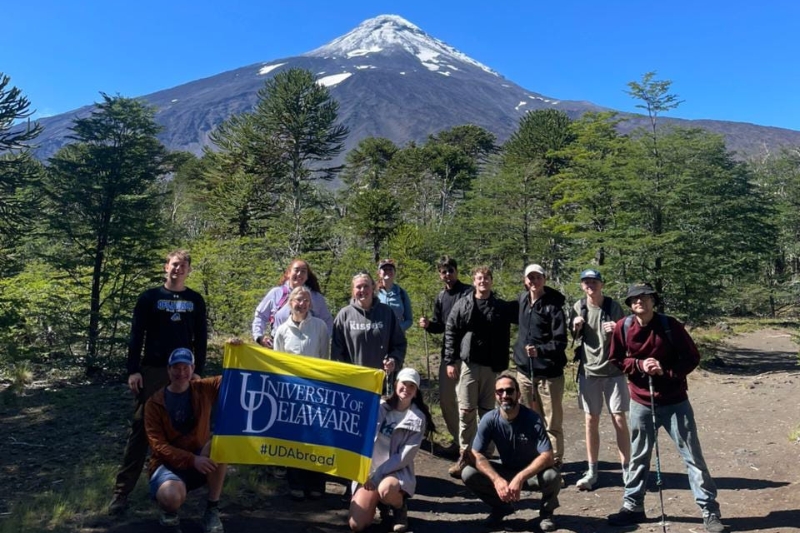
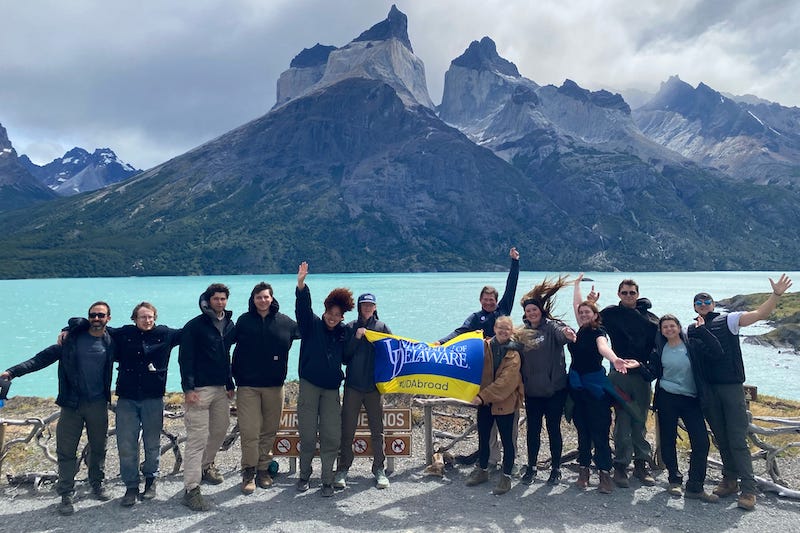
Eleven UD students got a crash course in sustainable development up close and personal to Patagonia’s snow-capped mountains, volcanoes, glaciers and dazzling blue lakes. Kent Messer, S. Hallock du Pont Professor of Applied Economics, led the group and taught students all about the region’s numerous sustainability challenges, including poverty and natural resource management. Students considered the ethical implications of governments, nonprofits and people trying to balance human welfare and environmental protection. Through the group’s face-to-face meetings with leaders of international forestry companies and their visits to contested forest landscapes, including areas claimed by Indigenous communities, the students saw firsthand the tension between economic development and the protection of native ecosystems and cultures. They also learned about coastal development alongside efforts to conserve fragile habitats further showing how environmental decisions in Chile are deeply shaped by history, ecology, culture, and economics.
Interning at fashion companies “down under”
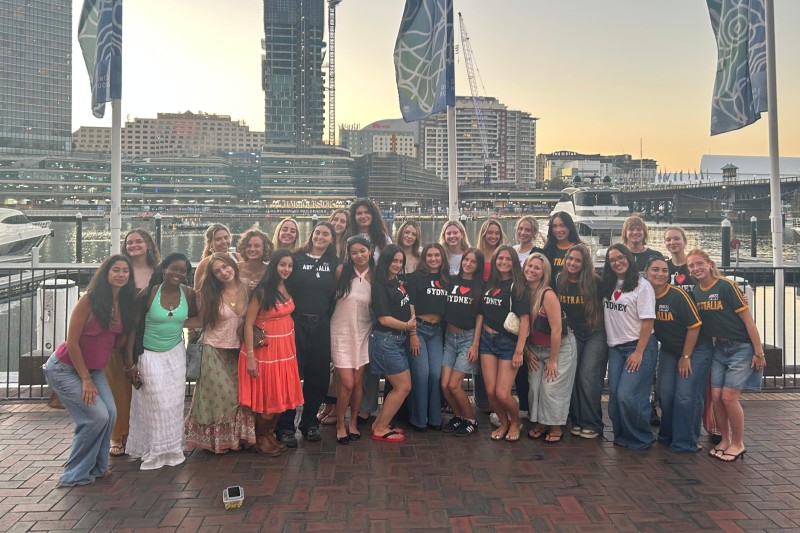
UD students who spent Winter Session “down under” in Sydney, Australia, worked as interns at several fashion businesses, including beachwear company Tolu, and visited the well-known brand Kulani Kinis. The program, offered by the Department of Fashion and Apparel Studies in the College of Arts and Sciences, also gave students opportunities to experience Australian culture and cuisine at places like Bondi Beach and the Sydney Zoo.
Vanessa Rack, a junior fashion merchandising major, said she was nervous about being so far from home, but the experience was the “best of her life so far.” Rack interred at Tolu, working on marketing-focused projects. “I got really close with my supervisor, who taught me leadership skills I will use for the rest of my career,” she said. “This is a time when you can strengthen your connections and knowledge, while also having the time of your life.”
Operating underwater technology in Palau
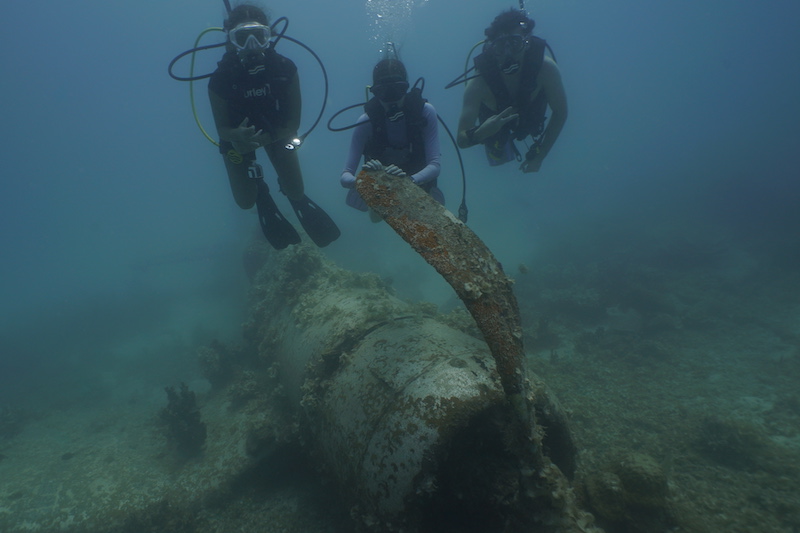
Using autonomous underwater vehicles that provide high-resolution sonar images of the sea floor, 14 undergraduates spent the winter session searching the waters of Palau, an island nation in the Western Pacific, to locate and repatriate missing World War II servicemembers. Led by the College of Earth, Ocean and Environment’s Mark Moline, Maxwell P. and Mildred H. Harrington Professor of Marine Studies and co-founder of Project Recover, students learned to program, maintain and operate the underwater technology, analyzed data to search for anomalies and man-made objects worthy of further investigation, searched terrestrial sites of interest, and documented the search efforts. With interests and majors spanning marine and environmental sciences, the students also worked with the Coral Reef Research Foundation to monitor Jellyfish Lake and studied the coral, fish, invertebrates and megafauna that inhabit the near-pristine reef ecosystems. To fully immerse themselves in the history and culture of the island nation, students met with the President of Palau and participated in excursions to lagoons, reefs and WWII battlefields.
Examining how disability is influenced by culture
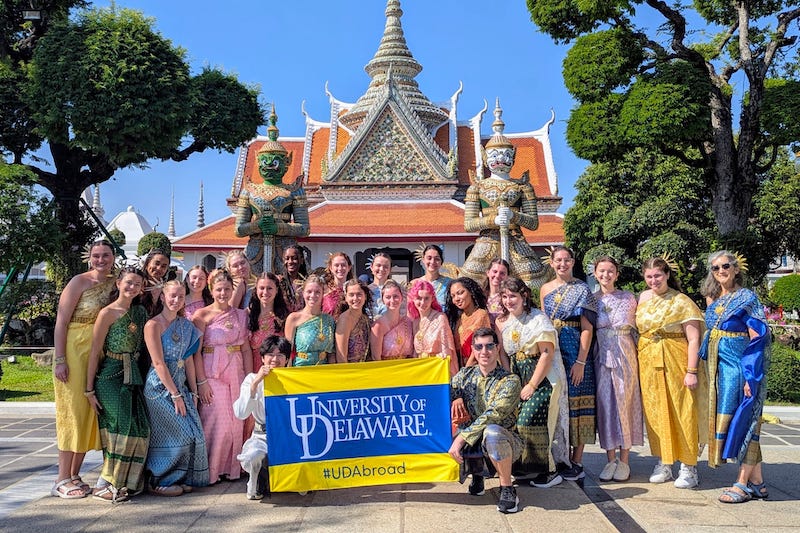
In this winter session program, students studied abroad in Thailand, including those in the College of Education and Human Development‘s disability studies minor. Led by Professor Laura Eisenman, students examined how disability is influenced by the culture in which one lives. They engaged with educational institutions, community services, government organizations and advocacy groups to learn about the way people with disabilities live, learn, work and play in Thailand. In addition to academic field trips, students learned about Thai culture through excursions to the Grand Palace, local markets, an elephant sanctuary and other attractions. Through the program, students studied in three exciting locations: the central district of Bangkok, the more rural and mountainous area of Chiang Mai and the seaside city of Chon Buri.
Blending public health, history and culture
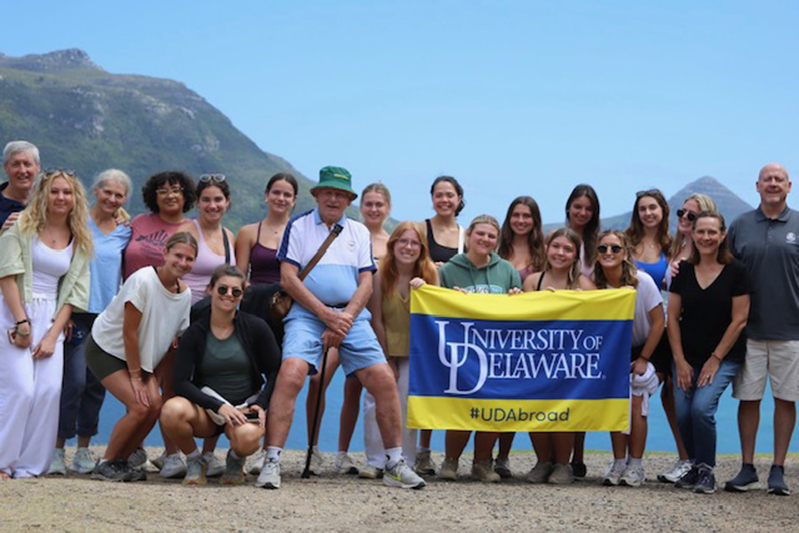
Sixteen students from the College of Health Sciences traveled to South Africa during Winter Session for an immersive study abroad experience that blended public health, history and culture. Led by Jennifer Thorpe, instructor and director of undergraduate nutrition programs, and retired Health Behavior and Nutrition Sciences Associate Professor Steve Goodwin, students explored the country’s public health challenges and the lasting impacts of apartheid-era inequities on local communities. The group visited Pretoria and Cape Town, volunteered with local health organizations and an HIV/AIDS orphanage, and learned about conservation efforts during a safari in Kruger National Park, where they spotted the Big Five. Students also visited the Kanyamazane Township, where they had a traditional chicken dust lunch and took a Zulu dance class.
“Some would say these people have nothing, but they have something we lack, which is priceless: ubuntu,” said Anna Copple, a sophomore integrated health sciences major. “Ubuntu is a Zulu word that speaks to shared humanity and how we’re all connected; it shows that who we are and how we thrive depend on community, compassion and looking out for one another. At home, I hope to live more intentionally by that mindset and bring a piece of what South Africa taught me into how I treat others every day.”
Exploring engineering in Siena
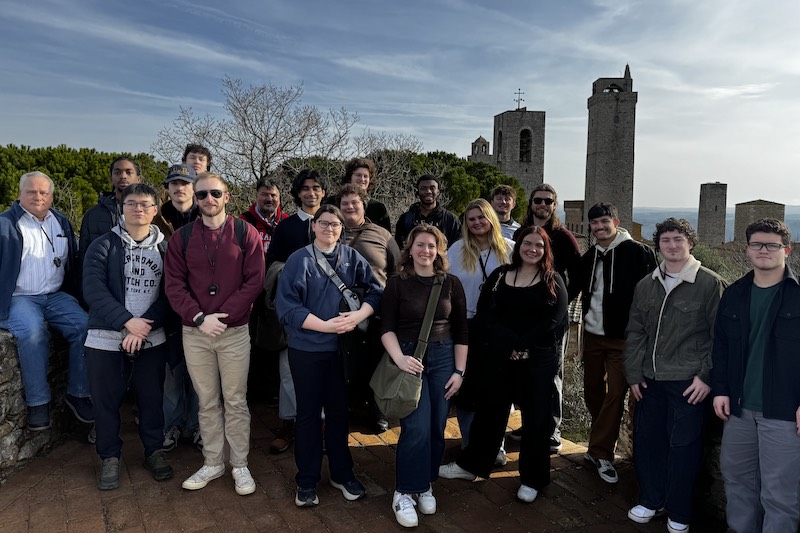
Eighteen undergraduates spent their winter term based in Siena, a city in Italy’s central Tuscany region, learning how medical imaging works, how embedded computers and sensors control devices and collect data, and how computational engineering helps solve complex problems. Alongside their engineering coursework, they explored Italian culinary traditions, Renaissance art and architecture, Roman mythology and the Roman Empire, and the history of electricity, electromagnetism and nuclear physics. Highlights included an Italian cooking class and group excursions to Rome, Florence and San Gimignano. Some students took the opportunity to travel farther afield, including weekend trips to France and Greece and snowboarding in the Dolomites.
“Studying abroad in Siena gave me the chance to fully experience Italian culture, explore a beautiful walkable city, travel with my class and make amazing friends,” said participant Paige Macry, a senior majoring in computer engineering.
Studying global sport event management
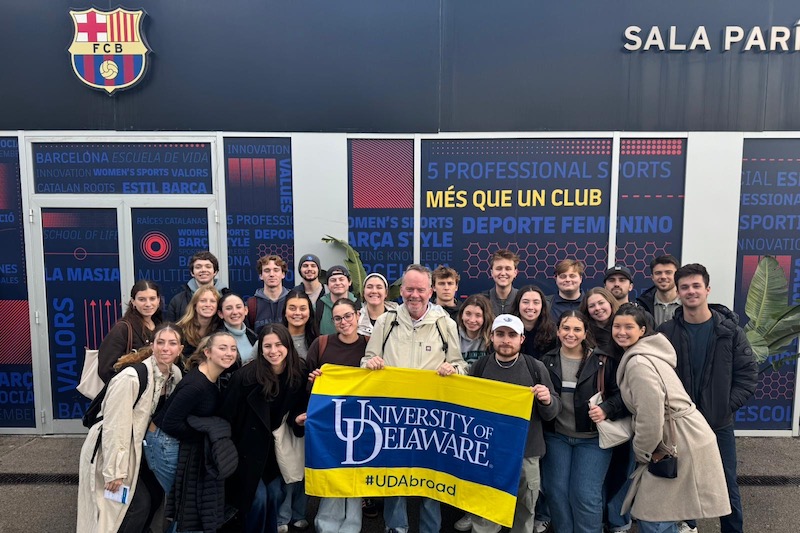
From sport governance and media production to venue operations and international marketing, experiential learning took center stage during a UD Winter Session study abroad focused on global sport event management. One of nine study abroad courses offered by UD’s Alfred Lerner College of Business and Economics, the course, led by Instructor of Sports Management John Allgood, immersed 31 students in four of Europe’s most influential sports cultures through hands-on learning across the Netherlands, Belgium, Germany and Spain.
The experience began in Amsterdam, where students examined the Dutch sport system through visits to Topsport Amsterdam and the Amsterdam University of Applied Sciences. They also explored sport media and production at ESPN Netherlands and toured Johan Cruijff Arena, home of AFC Ajax, with additional experiences in esports and korfball. In Brussels, students focused on sport governance and funding models during a visit to the University of Brussels, learning how public-private partnerships support athletic facilities and operations. A visit to RSC Anderlecht highlighted innovative premium seating strategies, corporate partnerships and the growth of women’s soccer. The program continued in Cologne with lectures at a leading sport management university, a visit to the German Olympic Museum and a live soccer match, before concluding in Barcelona. There, students attended lectures at the Blanquerna School of Health Sciences, toured Camp Nou and the Barcelona Olympic Stadium, and explored Catalan culture through guided tours, a cooking class and a visit to Montserrat.
“Experiential learning is at the heart of sport management,” Allgood said. “This program allowed students to learn directly from international executives while experiencing global sport culture firsthand.”
About Study Abroad and the Center for Global Programs and Studies
The Center for Global Programs and Services (CGPS) at the University of Delaware is home to the operations of UD Global, which includes Study Abroad, International Student and Scholar Services, World Scholars Program and Global Outreach and Partnerships.
In 1923, UD founded the first study abroad program by a U.S. institution. Today, UD offers 100+ programs in about 40 countries — and over 30% of UD undergrads study abroad at least once.
Students choose from semester-long programs in the fall and spring and shorter programs during winter and summer sessions. While abroad, Blue Hens take a full load of academic credits, choose to engage in internships or community service, and sharpen language and intercultural skills. Accommodations range from hotels (for some shorter programs) to residence halls, hostels and homestays.
Scholarships and financial aid are available for UD students participating in UD study abroad programs.
Follow and engage with @UDGlobal on Instagram and LinkedIn for the latest updates on everything global happening at UD and #UDAbroad.
Article by UDaily Staff.