



Black Girls with Green Thumbs
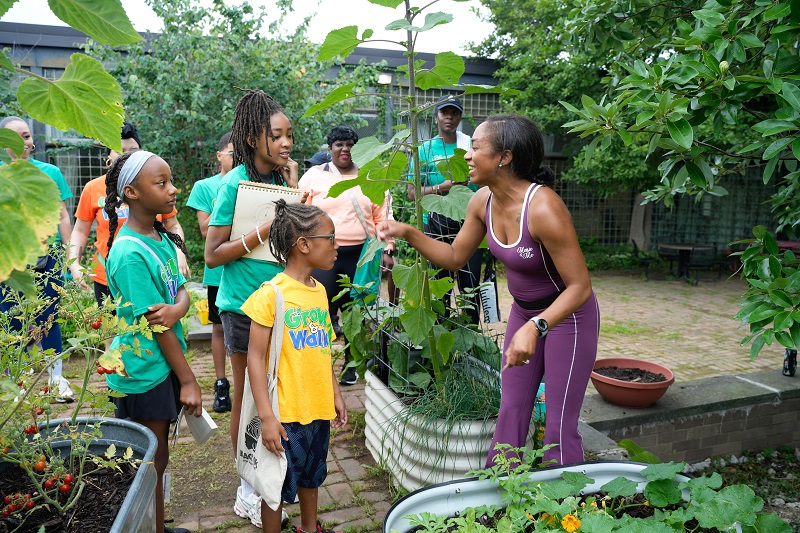
UD alumna supports Philadelphia area families with inclusive gardening and wellness education
As educators and pediatricians have often emphasized, outdoor learning and nature-based education benefits children across all areas of their development. These learning experiences promote health and wellness, foster scientific inquiry, strengthen community ties and so much more.
University of Delaware alumna Latiaynna King and Pamia Coleman, the co-founders of the Philadelphia-based nonprofit Black Girls with Green Thumbs, see the benefits of gardening and outdoor learning every day. King and Coleman offer inclusive and accessible gardening, nutrition and yoga programming to K-12 students and community members of all ages.
“Grounded in our work is an understanding that we are impacting family systems and nurturing the mental and social development of people across the lifespan,” said King, who graduated from the College of Education and Human Development’s (CEHD) master’s in human development and family sciences program. “As an urban garden and wellness organization, we are committed to building strong, resilient communities using wellness as a lens.”
Building strong, resilient communities is a thread that runs through all of Black Girls with Green Thumbs’ programming, from its partnership with Philadelphia elementary schools to its “Grow and Walk” events across the region. For example, their “Green Thumbs in Your School” program couples nutrition and gardening education with yoga instruction led by teachers certified in trauma-informed yoga. Their Gardeners Without Borders program, which teaches teens to run their own local farmstands, positions gardening as a tool for self-reliance and community building.
“My master’s degree set me up to build the foundation and grow Black Girls With Green Thumbs,” King said. “I studied and researched resilience, family systems, community development and more while at UD. I now apply that learning every day within the operation of our organization.”

Inclusive education is also a defining feature of Black Girls with Green Thumbs. Their programming in gardening, nutrition and yoga is designed to support multiple learning approaches, sensory needs, physical abilities and communication abilities. For example, rather than relying on lecture-based instruction, their programs emphasize hands-on, multi-sensory learning.
“Our participants engage directly with soil, seeds, plants and food preparation, allowing them to explore concepts through touch, sight, smell and taste,” Coleman said. “We use visual aids, modeling, simplified language and step-by-step demonstrations to support understanding, and we create opportunities for non-verbal or minimally verbal students to participate through choice-making, gestures or assistive communication methods.”
Their yoga programming also integrates sensory-informed wellness practices. Their activities emphasize breathing, grounding and gentle movement, offering seated, standing or floor-based options to accommodate different mobility and sensory preferences.
This dedication to accessible and inclusive learning stems from a personal connection. Coleman discovered that her autistic son enjoyed and benefited from gardening, which “became an unexpected doorway” for Coleman and her family.
“My son is non-verbal and has experienced food aversions, which is common for many children on the autism spectrum,” Coleman said. “What I discovered is that when he had the opportunity to grow food himself — by planting seeds, watering plants, watching them develop and then picking and cooking the herbs and veggies we grew — his relationship with food began to shift.”
“Gardening made food less intimidating and more familiar,” Coleman noted. “It gave him the chance to explore textures, colors and smells in a gentle, sensory-rich way that respected his pace. Over time, that curiosity opened the door for him to try foods he once rejected.”
Through their Green Thumbs In Your School program, King and Coleman have observed similar benefits for other autistic children in their community.
“Gardening naturally supports sensory exploration, patience and routine, which can be very regulating for autistic learners,” Coleman said. “It also creates a space where communication can happen in many forms such as movement, touch, observation and shared activity. In garden spaces, children who may struggle in traditional classroom settings often thrive because they are engaging their whole bodies and senses.”
Since King and Coleman founded Black Girls with Green Thumbs in 2016, they have served hundreds of children and families of all ages and abilities across Philadelphia and Delaware County, Pennsylvania. In the next three years, King hopes to “deepen our relationships with community partners and continue to grow our programs for children, mothers and families.”
Nature-based education at UD
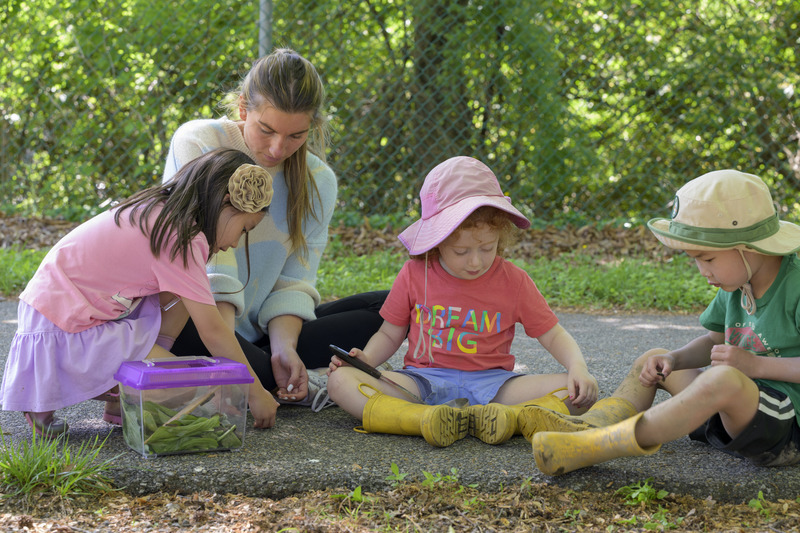
In addition to undergraduate and graduate degrees in education and human development, CEHD offers nature-based education for children and related learning opportunities for professionals. Through its Let’s Grow Outside! program, CEHD’s Delaware Institute for Excellence in Early Childhood offers gardening professional development for early childhood educators across Delaware. CEHD’s Lab School, which serves children from the ages of six months through kindergarten, offers nature-based education for children and related learning opportunities for UD student teachers, researchers and professionals.
Article by Jessica Henderson. Photos courtesy of Black Girls with Green Thumbs and by Kathy F. Atkinson.