



Inclusive Arts Education
UD offers professional development to support communication and inclusion for students with disabilities
April 27, 2026
April is National Autism Acceptance Month, a time to recognize, celebrate and advocate for autistic individuals, including those who may use augmentative and alternative communication (AAC) devices like picture boards or tablets with programmed vocabulary. Many students with disabilities enjoy the arts, finding opportunities for creativity and expression in painting or music. But access has often been limited. That’s why the Delaware Department of Education (DDOE) reached out to University of Delaware’s Center for Disabilities Studies (CDS) to help bridge that gap. “Delaware’s visual and performing arts educators have requested more opportunities for professional learning around supporting students with disabilities,” said Lauren Conrad, education associate for visual and performing arts and gifted at the DDOE. For that reason, CDS partnered with the DDOE to offer a professional development session tailored for visual and performing arts teachers from all three Delaware counties for the 2025-26 school year.
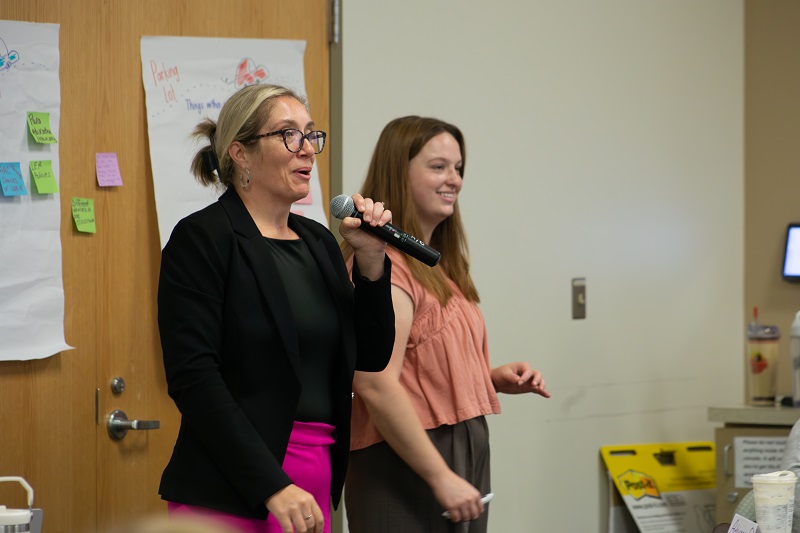
Titled “Communication as a Right,” the training helped teachers ensure that students aren’t just physically present in the classroom but fully participating. The session included strategies for including AAC users in the arts classroom as well as assistive technology (AT) demonstrations, led by Hannah Mennella, AAC specialist in CDS, and Angelia Wilt, instructional coach with the Multi-Tiered System of Support (MTSS) Technical Assistance Center. The MTSS Technical Assistance Center, established by the DDOE in partnership with CDS, provides professional learning and coaching for Delaware educators to support the academic and nonacademic development of all children through an integrated, multi-tiered system of support. This training for arts educators is just one example of ongoing partnerships between CDS and the DDOE across many programs and services to support individuals with disabilities, their families and educators. “As a speech language pathologist, AAC is my wheelhouse, but I know that a lot of educators in their preservice training are not well trained on how to interact with AAC users,” Mennella said. “There are some communication barriers that our AAC users experience just from communication partners not knowing how to interact with them.” The training, held in July 2025, focused on supporting meaningful interactions between educators and students by teaching educators how to plan their lessons with attention to vocabulary and pacing, among other topics.

For example, while many high-tech AAC devices come programmed with art vocabulary, the words are often basic or general. Students may have access to words like “draw,” “paint,” “crayons” and “brushes,” but they may not have access to language that describes more complicated art concepts or techniques. With this issue in mind, Mennella and Wilt taught educators to use “descriptive teaching,” a technique that uses a student’s core vocabulary to explain a more complicated concept. “If we’re talking about art history, ‘pointillism’ might not be programmed into an ACC device, but, when asked about pointillism by their teacher, a student could navigate to and say ‘many small dots make a big picture’ on their device,” said Mennella. “We’re helping teachers understand a response like that as valid and communicative, but also illustrating how they can support students in using language flexibly and model that skill on the device.” Mennella and Wilt also introduced educators to AT that could be helpful in the classroom, drawing from UD’s Assistive Technology Resource Centers in Newark and Milford, Delaware. As part of the state-funded Delaware Assistive Technology Initiative, the centers allow all Delawareans — including educators, other professionals and community members — to learn about, try out and borrow AT devices for free. According to Conrad, many arts educators have had few opportunities to engage with the various forms of AT. “Providing an opportunity to learn about AT and also a chance to use it will likely better prepare them to more effectively support their students,” Conrad said.
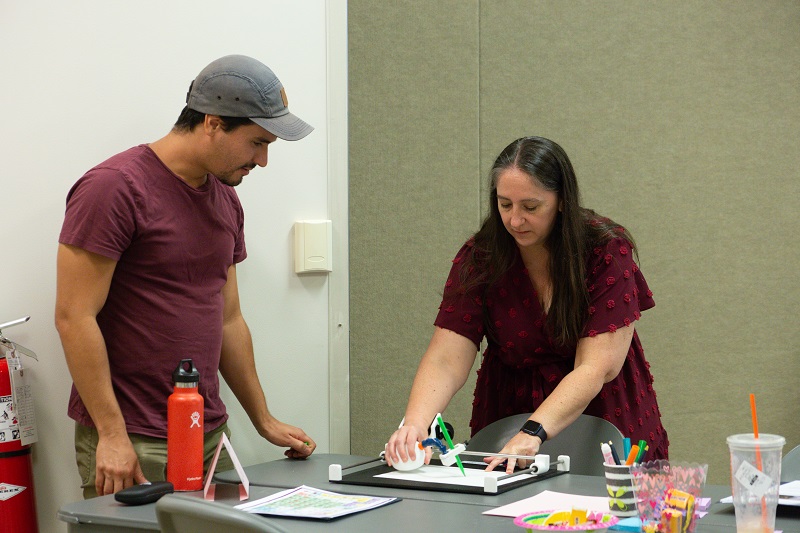
As the academic year comes to a close, that prediction has come true. “I knew about some of the adaptive equipment available, but I was unsure of who to contact for guidance. It is awesome to know there is a resource close to home,” said Gina Greeson, the general music teacher at Lulu M. Ross Elementary School in Milford, Delaware and a participant in the training. “For example, I now have a UKE buddy, an adaptive tool to ensure all students of all abilities have access to playing the ukulele.” Educators across the board found the session helpful. According to a post-session survey, all of the educators indicated that they knew “how to support a student who uses AAC with content specific vocabulary” and “strategies to create a communication rich classroom,” with nearly all educators indicating that they now knew “a lot” about these topics. “I found this workshop very helpful,” Greeson said. “It helped my classroom because it provided me with resources to ensure all students are successful. Knowing I have this support ensures that all students have equitable access to music and musical instruments.” “It was really cool to work with these arts educators and see how excited they were about inclusion around students with AAC devices and how they wanted to support them in participating fully,” Mennella said. “It’s so important that students with disabilities are included in the arts and in education in general. I find that a lot of our students with disabilities and those who use AAC really love the arts and have a passion for expressing themselves in a modality that is really fun and engaging.” Housed in UD’s College of Education and Human Development, CDS offers many programs and services to individuals with disabilities, their families and Delaware educators. For example, CDS offers the Career and Life Studies Certificate program for individuals with intellectual disabilities and the Spectrum Scholars program, a comprehensive college-to-career initiative for UD autistic students.
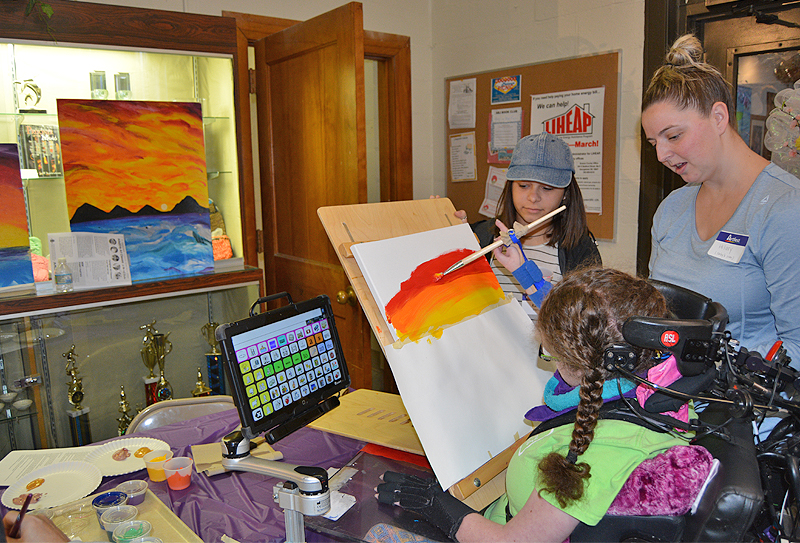
Header image caption: Students with disabilities often use adaptive devices to support their artistic work. Here, an ArtFest participant uses an adaptive tool during an ArtFest event. During the Center for Disabilities Studies’ training, visual and performing arts teachers learned how to support students with tools like this one and in other ways.
Article by Jessica Henderson and Carl Kanefsky. Photos by Jordyn Clifton and courtesy of the Center for Disabilities Studies. Read this article on UDaily.