



Building Connections and Community
Doctoral student supports youth with foster care experience, drawing on personal experience and strengths of UD’s program
As a young person with experience in the foster care system, University of Delaware graduate student William Woelki understands firsthand how important it is to support youth with foster care experience. The instability that youth often face in the foster care system — from access to food, school, housing and social relationships — can affect every aspect of their development.
“Being a youth with foster care experience has drastically shaped my work in the sense that everything I do is an effort towards leveling the playing field for my peers with systems-based experiences,” said Woelki, a doctoral student in the College of Education and Human Development’s (CEHD) Ph.D. in human development and family sciences (HDFS) program. “Whether it is writing a research paper, having a casual conversation or working on my dissertation, I strive to make sure the foster community isn’t left out of the conversation.”
Now in the fourth year of his program, Woelki is actively working toward those goals. Drawing on his personal and UD experiences, he has founded a mutual aid initiative to support those experiencing housing insecurity, advocated for federal policy changes and examined the educational barriers and supports for youth in foster care.
See You Backpacks
Woelki’s advocacy work is closely tied to his community-engaged coursework and research at UD. In just his second year of the Ph.D. program, Woelki and his friend, Phun Mualcin, established See You Backpacks, an initiative that provides filled backpacks to those experiencing housing instability.
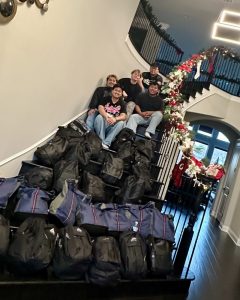
“This idea came to be when we realized that we couldn’t accept just walking by individuals experiencing housing instability without doing anything about it,” Woelki said. “We started with fundraising on social media, and I was honestly just amazed by how willing people were to help, especially members of the Burmese community.”
With the help of family and friends, Woelki and Mualcin fill backpacks with clothing, hygiene items, food and other essentials for people in need. To date, they have handed out more than 200 backpacks in Texas, Tennessee, Maryland and Delaware.
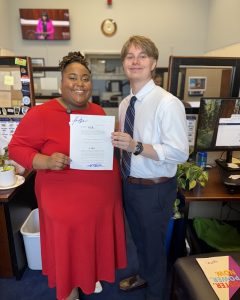
In addition to founding See You Backpacks, Woelki has advocated for federal policy changes in support of youth in foster care. As a Congressional Leadership Fellow with the National Foster Youth Institute (NFYI), Woelki traveled to Washington, D.C., in June 2025 and advocated for the Campus Housing Affordability for Foster Youth Act. This bill would allow current and former foster youth to use the U.S. Department of Housing and Urban Development’s Housing Choice Voucher Program to pay for college housing.
“Through this partnership with NFYI, I worked with Representative Greg Landsman to support the introduction of a bipartisan bill aimed at improving housing stability for college students with foster care experience,” Woelki said. “Seeing youth-driven advocacy turn into actual policy shows how essential lived experience is for effective systems change. I see this bill as a critical step toward making higher education a place where students with foster care experience are seen, heard and uplifted.”
Woelki’s UD experience
Woelki’s research examines systemic barriers to education in an effort to improve their post-secondary education outcomes. According to the NFYI, less than 10% of youth with foster care experience earn a college degree.
“It’s difficult to take the ACTs, complete the FAFSA or even begin the college application process when a student is worried about what happens after they age out of the foster care system or if they will see their siblings again soon,” Woelki said.
Importantly, Woelki’s dissertation also explores support systems, as well as factors that contribute to this community’s academic success.
“Research and even media often rely on deficit-based stories to attract attention to youth with foster care experience,” Woelki said. “However, there are a ton of youth with foster care experience who are thriving. I want to highlight more of that when possible.”
His dissertation uses participatory action research, an approach that directly involves the community affected by an issue through interviews and focus groups with youth in the foster care community. This asset-based, community-informed approach was influenced by the research and mentorship of faculty across UD.
“During my time as a research assistant in Roderick Carey’s lab, we discussed how a lot of research is a ‘me search’ that helps you make sense of your own experiences. For me, I think a lot of my work is a ‘we search,’” Woelki said. “Now more than ever, there is a vibrant community of youth with foster care experience all around the country working towards change. I’ve met so many youth and young adults who are passionate about being included in research teams, conversations and projects.”
Woelki also notes that his work is heavily influenced by his advisor, Ann Aviles, associate professor in CEHD’s Department of HDFS, and Yasser Payne, professor of sociology in the College of Arts and Sciences’ Department of Sociology and Criminal Justice.
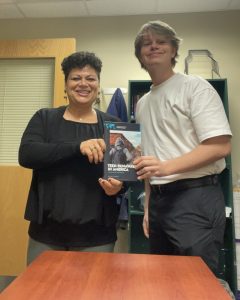
“William and I have had many conversations about conducting research that is not ‘extractive’ or harmful, and is instead inclusive and restorative,” said Aviles, who studies social policies and services for youth experiencing housing insecurity. “He really wanted his research to be asset-based in an effort to highlight the strengths and insights of youth with foster care experience, and importantly, to support their agency and voice in shaping and driving research that is mutually beneficial, methodically rigorous and youth-centered.”
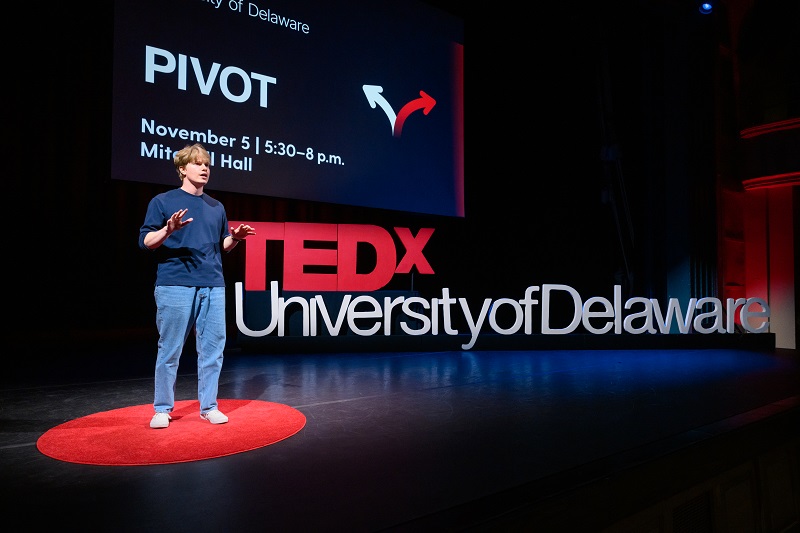
Since joining UD’s program in 2022, Woelki has presented his work at conferences within UD and across the region. Most recently, he participated in the 2025 TEDxUniversityofDelaware event in November with a talk titled “FosterED: The Realities of College for Youth with Foster Care Experience.”
Resources for UD students
UD’s Office of Student Support and Advocacy offers many resources for students struggling to maintain access to adequate housing, utilities or transportation. This office provides resources for those in need of food and supplies, clothing, child care and other support.
For students or others interested in Woelki’s line of research, visit Woelki’s student biography, CEHD’s webpage on research in family policy and services or the Department of HDFS’ overview of graduate programs.
Article by Jessica Henderson. Photos by Evan Krape and courtesy of William Woelki.