



Teaching Multilingual Learners
During Latine and Hispanic Heritage Month, UD shares supports for Delaware multilingual students and their teachers
During a reading lesson, Mateo, an elementary multilingual learner (MLL) in a Delaware public school, read “sit” as “seat.” Jon Kittle, his reading interventionist, walked him through the short vowel sound, but Mateo made the same “mistake” and grew frustrated.
Every day, Delaware educators teach MLLs, or students whose home language is not English, and many experience the same frustrations as Mateo. With more than 19,000 MLLs in the state, the University of Delaware is working during Latine and Hispanic Heritage Month this fall and year round to support these students and their teachers.
College of Education and Human Development (CEHD) faculty and staff share steps that all teachers can take to help MLLs thrive, emphasizing that a student’s home language can be an asset — not a barrier — in their education.
1. Leverage home language resources
In support of Delaware teachers, Associate Professor Christina Budde, Professor Steve Amendum and doctoral student Jon Kittle published an enhanced understanding of the Science of Reading for MLLs in January 2026, offering effective strategies for the classroom that make use of students’ home languages.
“Rather than seeing home languages as obstacles, educators can tap into students’ full linguistic resources to boost their literacy skills,” said Budde, who specializes in literacy and language education in CEHD’s School of Education (SOE). “Our review highlights that skills from students’ home languages — like vocabulary and comprehension — play a key role in supporting English literacy development.”
For example, they encourage educators to use resources available in a student’s home language to support instruction, like online translation tools and multilingual media. Teachers can also build rapport with the student’s community, consulting with a bilingual colleague, family member or community partner to check accuracy.
2. Implement cognate instruction
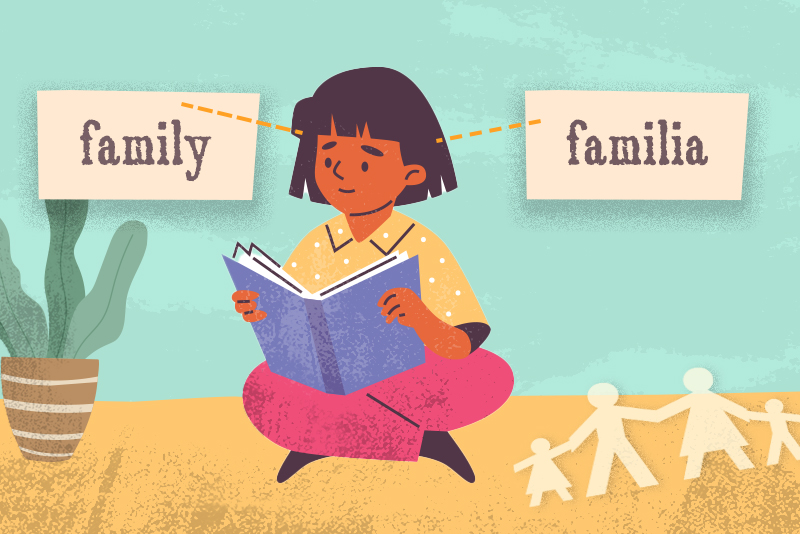
Budde, Amendum and Kittle also encourage educators to teach new vocabulary with cognates, words like “family” and “familia” that share similar forms and meanings in English and Spanish. Teachers could create a visual cognate chart, pairing the new English word with a picture and the familiar word from the student’s home language.
“In a unit on belonging to a community, for example, teachers could pair words like ‘different,’ ‘similar’ and ‘group’ with the Spanish words ‘diferente,’ ‘similar’ and ‘grupo,’” said Amendum, who directs the SOE and specializes in literacy education and professional learning for MLL teachers. “Teachers can create these charts with their students, emphasizing linguistic connections and addressing false cognates — words that look similar, but don’t share the same meaning across languages.”

3. Use the preview-view-review strategy
Another helpful strategy is “preview-view-review,” a tool that teachers can use to support MLLs’ reading comprehension by building background knowledge and making content more accessible.
First, the teacher “previews” the lesson using the student’s home language to introduce the topic or concept and then uses English to teach (or “view”) the lesson. The teacher then ends the lesson by“reviewing” or summarizing the lesson in the student’s home language. Teachers who do not speak their students’ home languages can use resources available online or recorded by bilingual colleagues to “preview” the lesson.
“As you prepare for the ‘preview,’ identify the most important background information that students need to understand the lesson,” Budde said. “Ask yourself, ‘What is the ‘big picture’ of this topic or unit? How does what I’m teaching connect to my students’ lives? What kinds of activities, readings or media would help me make those connections?’”
4. Consider a UD certification or degree program
If those strategies pique your interest, consider returning to the classroom as a UD student. CEHD supports teachers working with MLLs at every stage of their development, from initial teacher certification to graduate programs and professional development. Across all programs, students develop content knowledge and advanced skills through coursework and immersive practicum experiences in Delaware schools.
The undergraduate program in elementary and middle school teacher education offers a concentration in MLL education with coursework in linguistics, language development, methods for teaching MLLs and more. CEHD also offers alternate routes to initial teacher certification outside of traditional degree programs.
At the graduate level, CEHD offers a master’s degree in teaching English as a second language and an online master’s in literacy. Both programs can lead to K-12 certification as a specialist — as a teacher of MLLs or as a reading or literacy specialist, respectively. Outside of a master’s program, current Delaware teachers can also prepare for certification as a Teacher of English Learners or Bilingual Teacher through CEHD’s course of study.
5. Partner with CEHD in professional learning
Interested in learning more through your school or district? CEHD’s School Success Center (SSC) collaborates with schools, districts and education agencies through meaningful professional development tailored to each partner’s needs. This school year, you’ll find SSC staff working with MLL teachers and leaders in partnership with the Delaware Department of Education (DDOE), Seaford, Capital and Caesar Rodney School Districts and the Alexandria International Academy in Virginia.
Since 2023, Associate Professor Adrian Pasquarella and English Language Institute Professor Nigel Caplan have also partnered with DDOE on the statewide Project DELITE (Delaware English Learners’ Impact on Teacher Education). The five-year project supports teachers and education paraprofessionals as they take the UD courses necessary for certification as a Teacher of English Learners or a Bilingual Teacher. They also participate in a professional learning community.
“At the end of the day, our goal isn’t just to help teachers earn certification — it’s to transform the way schools in Delaware approach MLLs,” said Pasquarella, who specializes in MLL literacy instruction in CEHD. “When educators feel confident and supported, MLL students thrive. That’s the real impact we are working towards with Project DELITE.”
To learn more about CEHD research in MLL education, visit its research webpage. To partner with CEHD in professional learning, visit the School Success Center.
Article by Jessica Henderson. Illustration by Jeffrey C. Chase. Photo by Evan Krape.